
What Has Headlights, Armour, and a Bad Temper? Meet the Pinecone Fish cleidopus gloriamaris.

Updated: Jun 25

A swimming pineapple that glows in the dark, hides all day, and grumbles when you wake it. Allow us to introduce you to the pinecone fish, cleidopus gloriamaris.
Picture this. It's the dead of night on a shallow Australian reef, the kind of dark where you can't see your own hand. Then, tucked under a ledge, two soft greenish lights blink on. Steady. Eerie. Almost as if something switched them on deliberately. No torch, no moonlight. Just a small, round fish quietly glowing in the black.
That little lantern-bearer is the pinecone fish, Cleidopus gloriamaris, and yes, the glow is the showstopper. But the glow is only the doorway. Walk through it and you meet one of the ocean's odder, more charming characters.
First, the fish itself
If you saw one in daylight, "glowing wonder" probably isn't the phrase that would spring to mind. "Swimming pineapple," maybe. The pinecone fish is small, rounded, and wrapped in tough, plate-like scales edged in black, so the whole body looks like pineapple skin, or a knight's suit of armour. That second look earned it the nickname knightfish (McGrouther, 2021).
A few quick facts to picture it:
Size: grows to around 25 cm small enough to cup in your two hands (McGrouther, 2021).
Armour: rigid, bony plates (scutes) rather than the soft, flexible scales most fish have which is why it's also called the coat-of-mail fish (Froese & Pauly, n.d.).
Home: reefs off the east and west coasts of Australia, though, oddly, not Victoria or South Australia (McGrouther, 2021).
Where it hides: from shallow reefs down to around 200 m, sheltering in caves and under ledges by day (Froese & Pauly, n.d.).
Name: gloriamaris means "glory of the sea" not bad for a fish shaped like fruit.
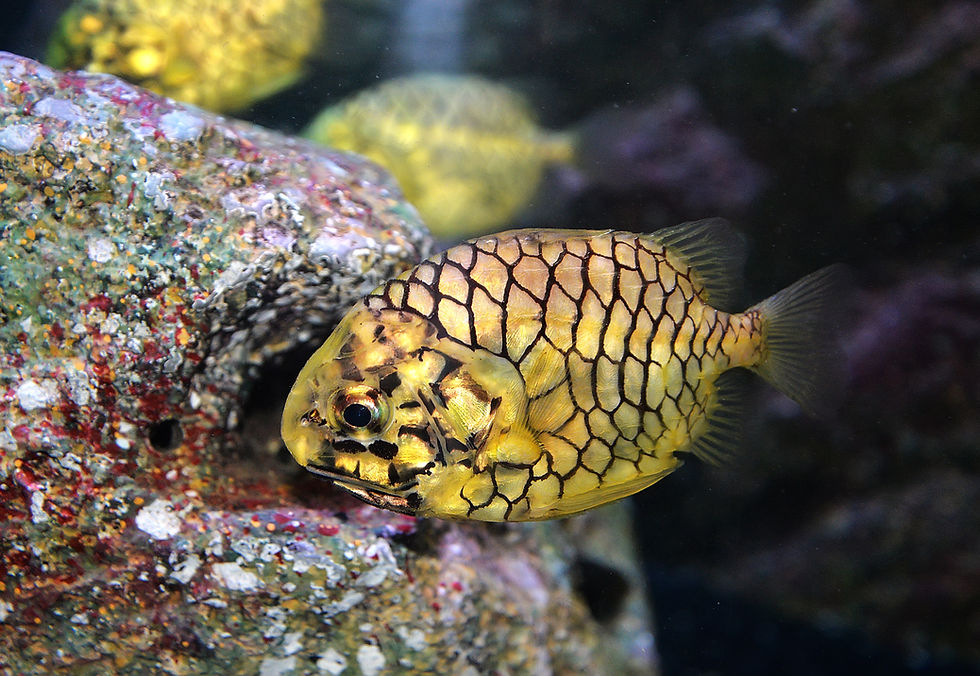
It isn't built for speed. All that armour makes it a slow, deliberate swimmer, so rather than outrun trouble it tends to just sit tight and wait it out.
Now, the glow
Here's where it gets genuinely strange. On each side of the lower jaw, the pinecone fish carries a light organ, one on the left, one on the right, like the red-and-green navigation lights on a ship. Naturalists spotted that resemblance long ago, which is how it picked up yet another nickname: the port-and-starboard light fish.
But the fish isn't actually making the light itself. It's renting the service out. Inside those organs live colonies of glow-producing bacteria (Vibrio fischeri), and they do the shining (Fitzgerald, 1977).
The pinecone fish (cleidopus gloriamaris), offers them a safe, nutrient-rich home; in return, they light it up. It's a partnership, not a party trick.
The result:
A soft greenish glow in younger fish that's reported to shift towards red as the fish ages (McGrouther, 2021).
Light that stays on through the night, when the fish does its hunting.
A built-in headlamp that helps it pick out tiny prey in the dark, its food is detected by the very light its lodgers produce (McGrouther, 2021).
This glow has fascinated scientists for decades. The pinecone fish's light organ was carefully described back in the 1960s (Haneda, 1966), and the bacteria behind it were studied and identified in the 1970s (Graham et al., 1972; Fitzgerald, 1977). It's still one of the cleaner, clearer examples of a fish and a microbe living in genuine partnership.

A quiet life behind armour
For all the drama of the glow, the pinecone fish lives a fairly low-key life. By day it stays hidden away in caves and crevices, often in small groups, and at night it heads out to feed with its headlights on. Disturb it and it's even said to make a faint creaking sound, a grumpy little protest from a fish that clearly values its privacy (McGrouther, 2021).
Put it all together and you get an animal that has solved the problem of being small and slow in a dangerous ocean in a wonderfully unusual way: wear armour, hide by day, and carry your own light into the dark.
Why a glowing pineapple matters
It would be easy to file the pinecone fish under "weird and wonderful" and move on. But it's quietly making a bigger point.
The glow isn't magic, and it isn't solo, it's cooperation. A fish and a colony of bacteria, two completely different forms of life, working out a deal that suits them both. The ocean is full of these partnerships, and the more closely we look, the more of them we find. They're a reminder that survival down there is often less about competition than about who you team up with.
And the pinecone fish is only one face in a very crowded sea. Beneath the surface there are countless other small, strange lives quietly getting on with the business of survival, most of them never seen by anyone. Once you've met even one of them, it's hard to look at the ocean quite the same way again.
So the next time someone tells you the ocean is "just the ocean," you've got your comeback ready: somewhere off the coast of Australia, a fish shaped like a pineapple is cruising a midnight reef with its own pair of bacterial headlights.
The ocean is anything but ordinary. It's just waiting to be revealed.
References
Fitzgerald, J. M. (1977). Classification of luminous bacteria from the light organ of the Australian pinecone fish, Cleidopus gloriamaris. Archives of Microbiology, 112(2), 153–156. https://doi.org/10.1007/BF00429328
Froese, R., & Pauly, D. (Eds.). (n.d.). Cleidopus gloriamaris, Australian pineapplefish. FishBase. Retrieved June 7, 2026, from https://www.fishbase.se/summary/SpeciesSummary.php?id=8210
Graham, P. H., Paxton, J. R., & Cho, K. Y. (1972). Characterisation of luminescent bacteria from the light organs of the Australian pine cone fish (Cleidopus gloriamaris). Archives of Microbiology, 81(4), 305–308. https://doi.org/10.1007/BF00412636
Haneda, Y. (1966). On a luminous organ of the Australian pine cone fish, Cleidopus gloriamaris de Vis. In F. H. Johnson & Y. Haneda (Eds.), Bioluminescence in progress (pp. 547–555). Princeton University Press.
McGrouther, M. (2021). Pineapplefish, Cleidopus gloriamaris De Vis, 1882. Australian Museum. https://australian.museum/learn/animals/fishes/pineapplefish-cleidopus-gloriamaris-de-vis-1882/


Comments